

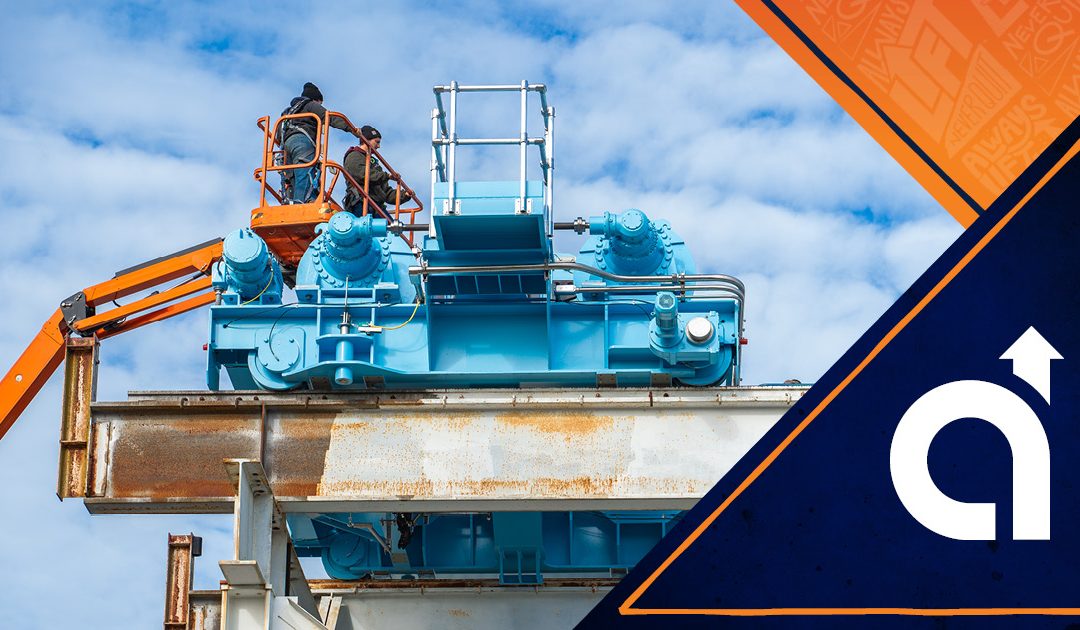
Overhead crane maintenance is often treated as a line-item expense, but for the facilities that get the most value from their equipment, it’s one of the highest-leverage investments they make. When budgeting for an overhead crane, it’s tempting to focus on the purchase price. But the facilities that get the most value from their equipment focus on something else entirely: uptime. A well-maintained crane keeps production moving. An unmaintained one eventually doesn’t, and that’s where the real cost shows up.
For many facilities, most of a crane’s lifecycle value is determined after the first year, not by the equipment itself, but by how consistently it’s maintained. A typical 10-ton crane operating at roughly 60% duty can face an estimated $348,000 in potential repair and downtime exposure over 10 years without a proactive plan, potentially three to five times its original purchase price. In high-duty environments such as steel mills and ports, that exposure can exceed $700,000.
These figures are planning benchmarks rather than universal totals. But they illustrate a simple point: preventive maintenance is one of the highest-leverage investments a facility can make in an overhead crane, because it converts an unpredictable risk into a manageable, budgeted plan.
Why Preventive Maintenance Pays for Itself
A strong maintenance program protects a facility in ways that are easy to overlook until something fails. A well-run plan typically delivers:
- Fewer surprises: scheduled inspections catch wear before it causes a failure
- Lower repair costs: planned parts replacement avoids expedited-shipping premiums and emergency labor rates
- Less lost production: predictable service windows replace unplanned stoppages
- Stronger compliance: documented maintenance supports safety records and reduces liability exposure
- Longer equipment life: consistent care delays costly replacement and protects your original investment
Facilities that treat maintenance as routine, rather than reactive, consistently spend less over the life of their equipment and lose far less production time to surprise repairs.
Why Year Five Is a Turning Point
Maintenance needs rarely stay level throughout a crane’s life. During the early years, service needs are relatively predictable. As equipment ages and components experience repeated loading, heat, vibration, and fatigue, that pattern shifts, and this is exactly where a proactive plan starts to pay off.
After year five, repair frequency can roughly double. Facilities with a documented maintenance history can anticipate major component service well ahead of time. Facilities without one are more likely to face it as an emergency, with the downtime and expedited costs that come with reacting instead of planning.
A strong maintenance plan builds value across three phases:
- Years 1–3: Establish maintenance records and confirm actual usage matches the specified duty cycle.
- Years 4–5: Use that service history to plan ahead for major component work before it becomes a failure.
- Years 6–10: Use accumulated data to time modernization or replacement on your own schedule, not the crane’s.
Build a Maintenance Plan Around How You Actually Operate the Crane
Duty cycle is one of the biggest factors in how much value a maintenance plan delivers. A crane designed for occasional lifting doesn’t need the same service rhythm as one supporting multiple shifts in a demanding production environment. As workloads or operating conditions change, the maintenance plan built around the crane’s original duty cycle may need to change with it.
That’s why lifecycle maintenance plans should be reviewed annually. Tracking service calls, parts, downtime, and changing production demands makes it far easier to catch small issues early, plan service windows around production instead of around breakdowns, and know with confidence whether continued maintenance, modernization, or replacement offers the best long-term value.
The most valuable crane isn’t necessarily the one with the lowest purchase price, it’s the one backed by a maintenance plan that keeps it reliable, safe, and running when it’s needed most.
American Crane & Equipment Corporation helps facilities build maintenance programs that protect uptime, extend equipment life, and turn unplanned repair risk into a predictable, manageable plan. Contact our team to schedule an inspection or build a lifecycle maintenance strategy that keeps your crane and your production running.