

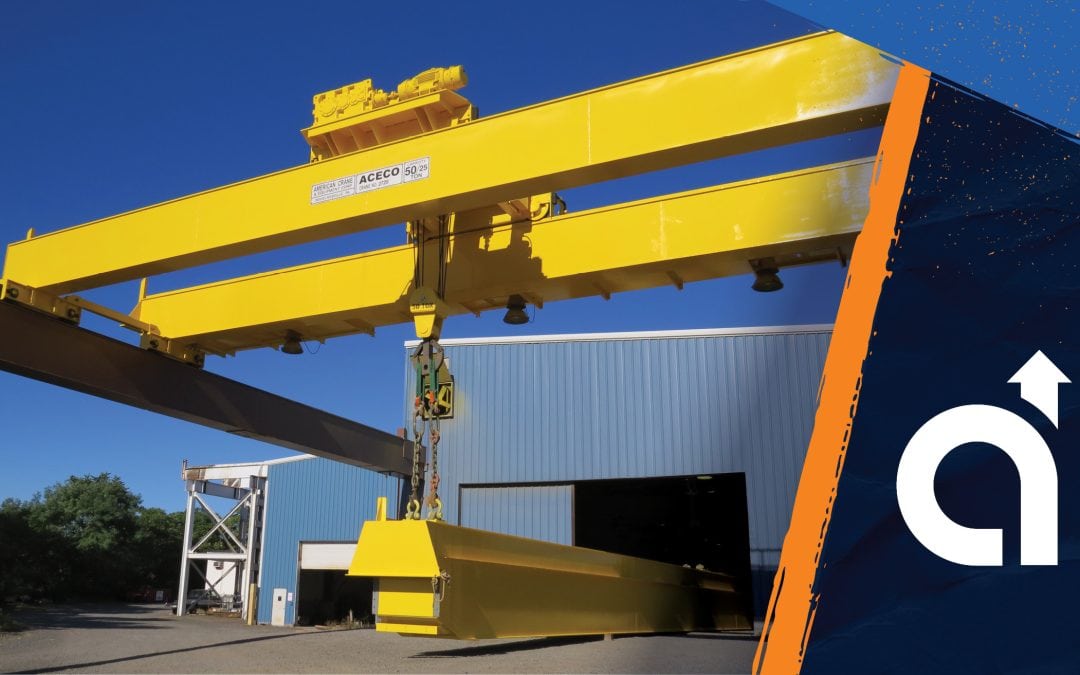
TL;DR: Defense crane systems at DOD facilities are evaluated on far more than lifting capacity. Qualification encompasses documentation, testing, operator competency, precision positioning requirements, risk mitigation measures, and long-term reliability considerations. Custom-engineered defense crane systems are frequently required to meet application-specific performance and compliance objectives.
In many manufacturing environments, an overhead crane is primarily a productivity tool.
In Department of Defense (DOD) facilities, it can be a quality-control system, a safety system, and a mission-assurance system all at once.
When overhead cranes are used to support precision assembly, handling of defense-related components, or movement of high-value equipment, the consequences of a lifting error extend far beyond production delays. A single incident can damage sensitive hardware, compromise quality requirements, trigger costly investigations, or disrupt major defense programs.
That is why DOD facilities and defense contractors typically approach crane selection and qualification with a zero-tolerance mindset.
Why Defense Crane Systems Procurement Is About Eliminating Surprises
In many industrial environments, a crane is evaluated primarily on capacity, speed, and cost.
Defense projects typically take a broader view.
Procurement teams are often tasked with answering a much larger question: What could go wrong, and how will the system prevent it?
That evaluation may include positioning accuracy, redundancy, traceability, maintenance access, testing procedures, quality controls, and documentation requirements.
The objective is not simply to purchase a crane. It is to reduce uncertainty before the crane ever enters service.
Precision Assembly Leaves Little Room for Error
Imagine lowering a high-value component into place where even minor load movement could affect alignment, require rework, or create delays.
In these environments, lifting capacity is rarely the limiting factor. Control is.
Overhead crane systems may need to deliver smooth acceleration, precise positioning, minimized load swing, and predictable motion throughout the lift. To achieve that level of performance, engineers often specify technologies such as variable frequency drives, anti-sway controls, load monitoring systems, automated positioning features, and custom-engineered lifting devices.
The result is a lifting operation that is more repeatable, more predictable, and better suited for demanding assembly processes.
A Qualified Crane Needs a Qualified Paper Trail
A crane may pass every performance test, but that is only part of the story.
For many defense-related projects, testing records, inspection procedures, maintenance requirements, operator qualifications, and certifications all become part of the qualification process. The goal is not simply to prove that the crane works today, it’s to create confidence that it can be operated, inspected, and maintained correctly for years to come.
That focus on documentation is one reason standards such as ASME B30 and CMAA place so much emphasis on training, inspections, maintenance, and operational responsibilities. ASME B30 standards, CMAA crane classifications
Because in high-consequence environments, “trust us” is rarely enough. The expectation is evidence.
Why Off-the-Shelf Isn’t Always an Option
A crane that works well in one defense facility may be completely wrong for another.
The requirements for positioning sensitive electronic assemblies, for example, can look very different from those for handling aerospace components or supporting naval manufacturing operations. Even facilities performing similar work may have different layouts, workflows, safety requirements, and qualification expectations.
That is why many DOD projects rely on custom-engineered crane systems rather than standard configurations.
The crane must fit the operation, not the other way around. That includes supporting the facility’s processes, documentation requirements, and long-term operational objectives.
How American Crane & Equipment Corporation Can Help
Defense facilities and government contractors often look beyond lifting capacity when evaluating an overhead crane system. Factors such as positioning accuracy, documentation, testing, traceability, and long-term reliability can all influence whether a solution is the right fit for the application. Balancing those requirements often calls for more than a standard, off-the-shelf approach.
American Crane & Equipment Corporation (ACECO) designs custom overhead crane and hoist systems for organizations that cannot afford surprises. From advanced controls and specialized lifting devices to comprehensive testing and documentation support, ACECO helps customers develop lifting solutions built for precision, repeatability, and confidence in demanding DOD and other high-consequence environments.