

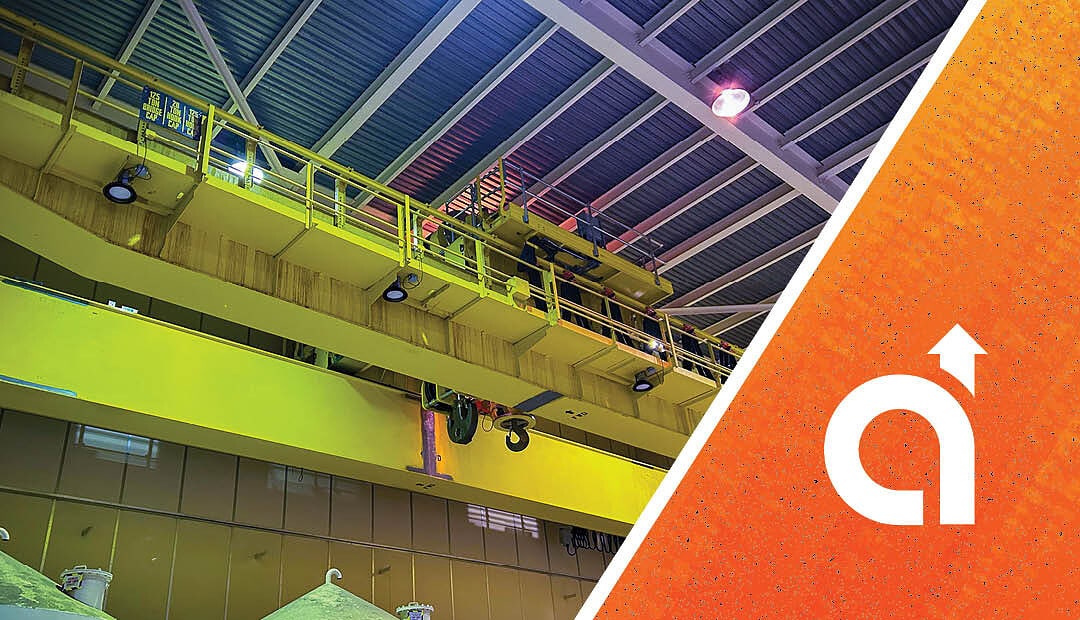
“Single failure-proof” sounds like a promise that nothing will ever break. It’s actually a specific engineering objective: no credible failure of a single component can cause an uncontrolled lowering or loss of the load.
The term describes how the lifting system responds to component failure, not the assumed perfection of its parts. Motors, brakes, wire ropes, controls, and electrical components can still wear or fail. The design objective is to keep any one of those failures from becoming a dropped-load event.
The principle has its roots in nuclear material handling but also applies to Department of Energy and defense operations, where the risks of a lift call for engineered controls.
The Whole Lifting System Is Considered
A single failure-proof crane can’t be created simply by adding a second brake or duplicating a control circuit. Engineers have to evaluate the complete load path and identify credible failure modes throughout the system.
The resulting design may incorporate dual reeving, redundant holding brakes, backup hoisting machinery, independent controls, protective interlocks, load monitoring, and site-specific seismic requirements. Ultimately, the mix depends on the application.
Those features need to function together. Redundancy offers limited protection if two supposedly independent systems share a common point of failure. The analysis extends beyond the hoist itself to the below-the-hook device, load attachment points, supporting structure, and operational controls.
Single failure-proof performance, in other words, is as much about system engineering and verification as it is about individual components.
Nuclear Facilities
Commercial nuclear plants use single failure-proof cranes and lifting systems for applications such as spent-fuel cask handling and the movement of heavy loads near fuel or safety-related equipment.
NRC guidance on heavy-load handling includes NUREG-0612, while NUREG-0554 addresses the design, fabrication, installation, and testing of single failure-proof overhead cranes. ASME NOG-1 provides construction rules for top-running, multiple-girder overhead and gantry cranes used at nuclear facilities. Which criteria apply depends on the facility’s licensing basis and the specific lifting application.
Department of Energy Facilities
DOE sites handle nuclear material, radioactive waste, specialized process equipment, and other loads tied directly to facility safety.
A DOE project may require single failure-proof equipment when a dropped load could release hazardous material, damage safety-related systems, or create another serious consequence identified in the facility’s safety analysis. DOE’s hoisting and rigging framework also sets additional planning and control requirements for certain high-risk lifts.
Defense Applications
Within Department of Defense programs, single failure-proof cranes may be specified for handling weapons-related components, naval equipment, aerospace hardware, or unique assets whose damage would carry unacceptable safety or program consequences.
Not every crane at a defense facility needs this classification. The most consequential lifts do, and the requirement itself typically comes from a procurement specification, facility design criterion, contractual standard, or formal hazard analysis.
Is a Single Failure-Proof Crane Required for Your Facility?
The industry alone doesn’t determine whether a single failure-proof crane is required. That comes from the load, the operating environment, applicable codes, the facility’s safety or licensing basis, and the consequences identified through engineering analysis.
American Crane & Equipment Corporation works through that analysis in-house. Engineering, manufacturing, testing, and documentation under a nuclear quality assurance program supports requirements such as 10 CFR 50 Appendix B and NQA-1.
For nuclear, DOE, and defense customers, that’s the part that matters most: not a label on the crane, but a documented, verifiable case for why it’s safe.