

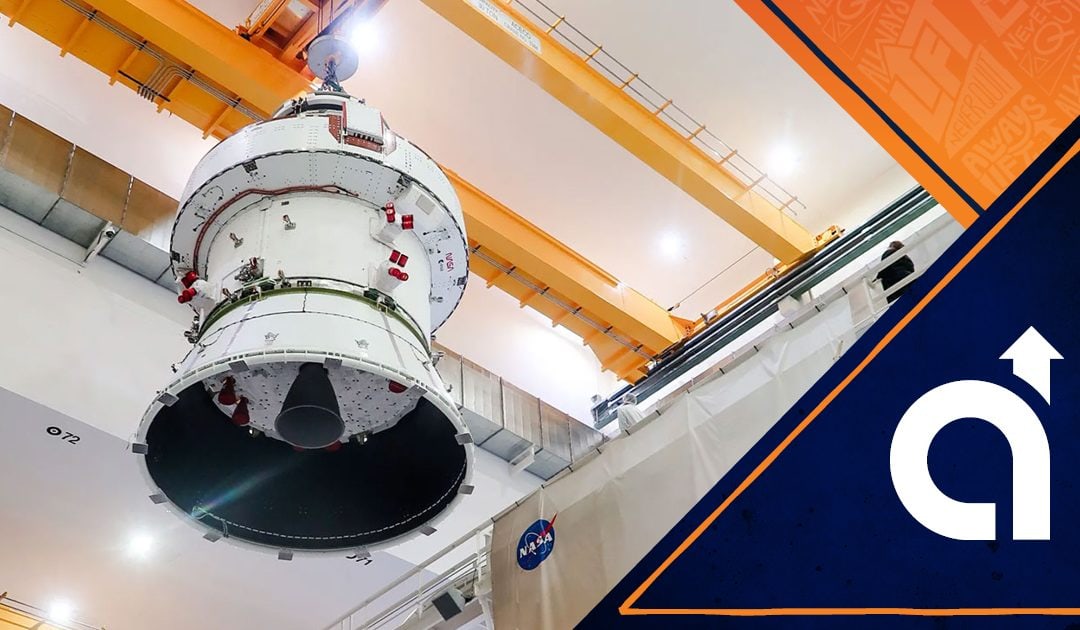
Artemis II has captured a lot of attention, and understandably so. It represents a major step forward in space exploration, supported by years of engineering, coordination, and manufacturing across a wide network of teams and facilities.
At American Crane & Equipment Corporation, programs like this tend to spark a different kind of curiosity. Beyond the design and fabrication, we’re always thinking about what happens throughout the build process—specifically how components are handled as they move from one stage to the next, and what it takes to maintain precision along the way.
In space-grade manufacturing, that handling process carries more weight than it might in other environments. By the time large components reach final assembly, tolerances are already tight and systems are often partially or fully integrated. At that stage, there is far less opportunity to make adjustments, which means earlier steps in the process, including lifting and positioning, play a meaningful role in the final outcome.
It’s something we see in a range of high-precision applications. As assemblies become larger and more complex, lifting is no longer just about moving material from one place to another. The way a load is controlled during a lift can influence how well components align later on, particularly when even small shifts can lead to fit-up challenges or added stress within the assembly.
Because of this, the expectations for lifting systems change. Capacity is still important, but it is only part of the picture. Control, stability, and consistency become just as important, especially when operators need to guide large or sensitive components into position with a high degree of accuracy. In some cases, this involves coordinating multiple lifting points to maintain balance, while in others it comes down to working carefully within limited clearances where precise positioning is essential.
For a program like Artemis II, these conditions are not occasional—they are part of the day-to-day reality within the facilities supporting the build. Each lift contributes in some way to maintaining alignment and protecting the integrity of the components being assembled.
That perspective is something we often share with customers. Lifting systems are typically viewed as supporting equipment, but in environments where precision matters, they become part of the process itself. When they are designed and applied thoughtfully, they can help reduce variability, improve consistency across repeated operations, and support the level of control that complex assemblies require.
Artemis II is an impressive achievement, but it also highlights the importance of the work that happens on the ground. The way components are handled throughout manufacturing plays a role in making that level of performance possible.
At American Crane & Equipment Corporation, we work with manufacturers who are operating under these kinds of conditions, designing lifting systems that support precision, repeatability, and long-term performance. It’s the same set of challenges we see across industries where alignment and consistency matter just as much as capacity.
If you’re taking a closer look at how your process holds tolerance from one step to the next, it may be worth looking at how your lifting systems are contributing to that.