

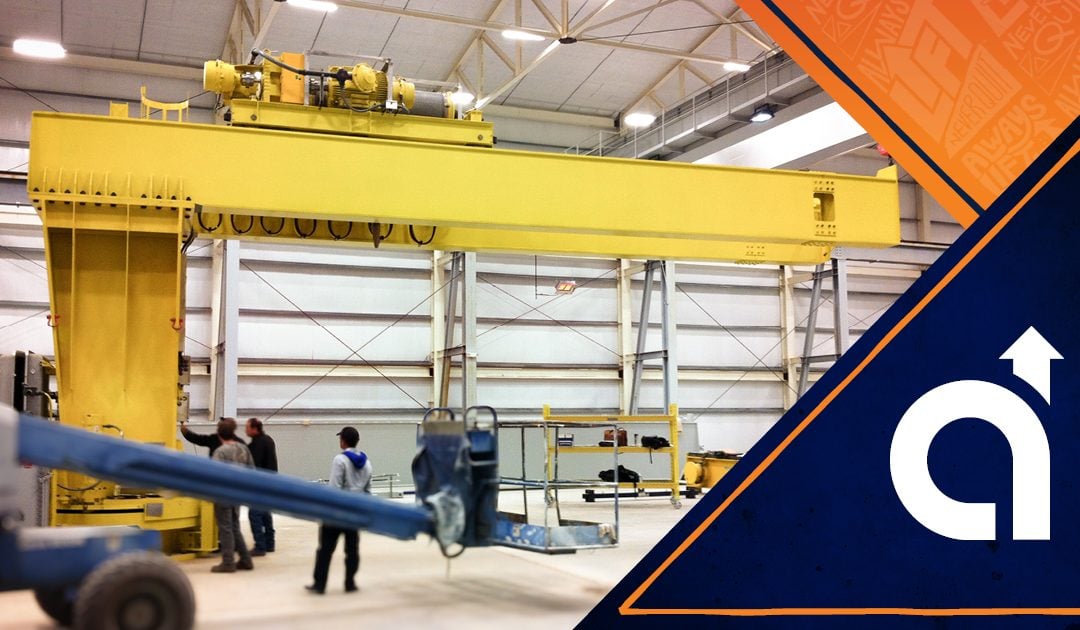
In most manufacturing environments, mistakes are costly. In nuclear, aerospace, and defense, they’re not an option.
These industries operate under a different standard—one where material handling systems aren’t just tools for moving loads, but engineered safeguards built into the process itself. Every lift, transfer, and positioning step must perform exactly as intended, every time. The margin for error isn’t small, it’s effectively zero.
That reality shapes how these sectors approach material handling in ways that are worth examining, even for operations outside of high-consequence environments.
Redundancy Isn’t Optional
In nuclear facilities especially, redundancy is designed into nearly every high-risk lift. Dual hoists, backup braking systems, and independent load paths aren’t nice to have—they’re required.
The thinking is straightforward. Assume something will fail, and design so it doesn’t matter.
For many facilities, this raises an important question: where are your single points of failure? Even if your operation doesn’t demand nuclear-level redundancy, identifying and mitigating those risks can prevent downtime that’s far more expensive than the equipment itself.
Precision Is a System, Not a Feature
In aerospace manufacturing, tolerances are tight and assemblies are complex. Material handling systems are expected to support that precision—not fight against it.
That means controlled speeds, smooth acceleration, exact positioning, and integration with surrounding processes. It’s not just about lifting capacity; it’s about how the lift behaves throughout the entire motion.
If your team is compensating for inconsistent movement or working around equipment limitations, that’s a signal. Precision shouldn’t rely on operator correction—it should be built into the system.
Documentation Drives Everything
Defense applications bring another layer: traceability. Every component, inspection, and procedure must be documented and verifiable.
Material handling equipment is no exception. From load testing and maintenance records to compliance with standards like CMAA, ASME, or HMI classifications, documentation becomes part of the product itself.
This level of rigor often feels excessive—until it’s needed. When something goes wrong, the ability to trace back through decisions, inspections, and performance history is what allows teams to respond quickly and confidently.
Designing for the Environment
Across all three sectors, one principle that shows up consistently is equipment that is designed for the environment it operates in, not just the load it carries.
That might mean corrosion-resistant materials in nuclear settings, cleanroom-compatible designs for aerospace manufacturing, or ruggedized systems for defense applications. The lifting solution isn’t generic. It’s purpose-built.
For many operations, this is where gaps start to appear. Equipment selected for capacity alone can struggle when exposed to real-world conditions over time.
What This Means for Your Operation
Most facilities aren’t launching spacecraft or managing nuclear reactors. But the underlying principles still apply.
- Where are the failure points in your current system?
- How much of your precision depends on operator skill versus system design?
- Do your documentation and maintenance practices support fast, confident decision-making?
- Is your equipment truly matched to your operating environment?
These aren’t theoretical questions. They directly impact uptime, safety, and long-term performance.
Where Experience Matters
High-consequence industries don’t leave material handling decisions to chance. They rely on partners who understand how systems perform in real operating conditions, not just how they’re specified on paper.
That same approach can make a measurable difference in more traditional environments.
American Crane & Equipment Corporation works with teams to evaluate these challenges and design lifting solutions that hold up over time—built for the realities of your operation and backed by responsive support.
If you’re rethinking how your systems perform under pressure, we’re ready to help.