

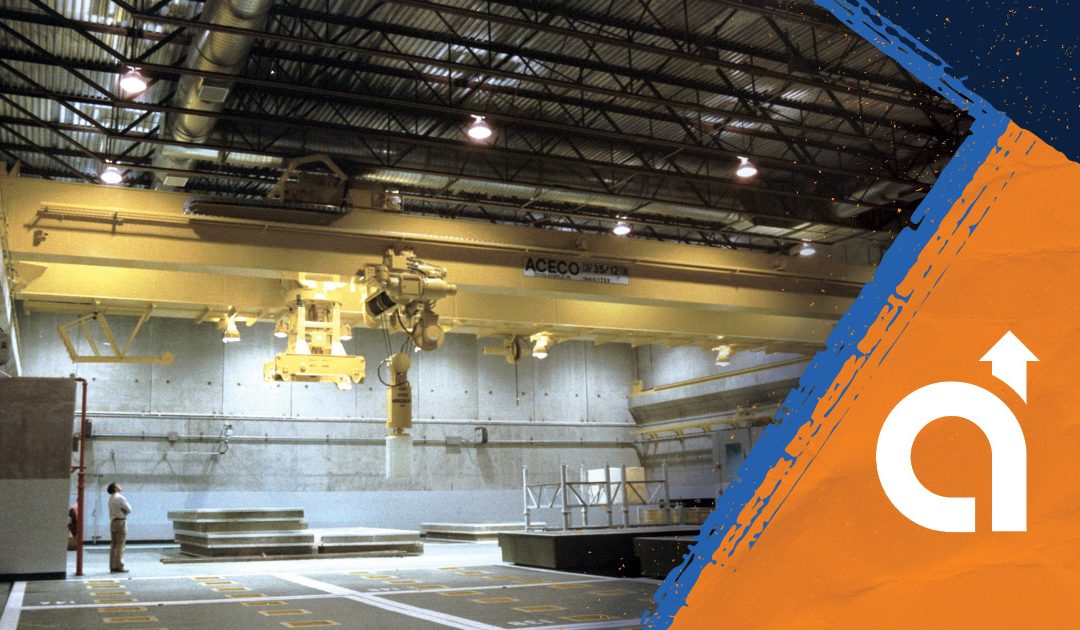
If your facility is operating overhead or gantry cranes built to ANSI B30.2-1976 standards, now is the time to evaluate an upgrade. Aging crane systems can impact safety, reliability, and compliance, especially as operational demands increase or regulatory requirements evolve.
For industries like nuclear, manufacturing, and heavy fabrication, modernization is not just maintenance. It is a strategic investment in uptime, safety, and long-term performance.
Why Upgrade Your Overhead Crane?
Legacy crane systems were not designed with today’s safety features, diagnostics, or precision control capabilities. While structurally sound cranes can remain in service for decades, outdated components increase the risk of failure.
One of the most common causes of overhead crane failure is two-blocking. Modern upgrades introduce redundant hoist limit switching to significantly reduce this risk while improving operator confidence and equipment protection.
In addition, targeted upgrades address high-wear components that commonly lead to downtime, including:
- Bridge and trolley wheel bearings
- Bridge rail alignment and runway conditions
- Conductor bar and festoon systems
- Wire rope sheaves and associated bearings
These improvements extend crane life while reducing unplanned maintenance.
Modernizing Crane Controls with VFD Technology
Upgrading from contactor-based controls to Variable Frequency Drives (VFDs) is one of the most impactful improvements you can make.
Modern VFD systems provide:
- Full torque at any speed, including low-speed precision
- Smooth acceleration and deceleration to reduce shock loading
- Synchronized hoisting for tandem crane operations
- Enhanced braking control for safer load handling
This results in improved load control, reduced mechanical stress, and increased operational efficiency.
Advanced Crane Safety Features
Unlike older systems, modern overhead crane upgrades include built-in safety functions designed to actively protect both operators and equipment:
- Safe Torque Off (SIL3) for emergency stop functionality
- Load monitoring and overload protection
- Torque proving before brake release
- Slack cable and shock detection
- Programmable exclusion zones to prevent unsafe load travel
These features help maintain safe operating conditions and reduce the likelihood of costly incidents.
Improving Performance and Precision
Modern crane systems provide superior motion control, allowing for:
- Stepless speed control for smooth operation
- Micro-speed capability for precise positioning
- Load float functionality to maintain position without brake wear
- Integrated sway control to reduce load swing
The result is improved productivity, better load handling, and less wear on crane components.
The Importance of Crane Inspection and Maintenance
A successful crane upgrade goes hand-in-hand with a robust inspection and maintenance strategy.
Crane Wheel and Runway Alignment
Proper wheel condition and alignment are critical to safe crane operation. Inspections should include:
- Visual checks for cracks, wear, and deformation
- Dimensional measurements based on CMAA standards
- Alignment verification to prevent skewing and rail damage
- Bearing condition and lubrication checks
Misalignment can lead to uneven loading, excessive wear, and structural stress.
Wire Rope and Sheave Upgrades
Modern standards require more rigorous inspection criteria than those in place in 1976. Upgrading these components ensures:
- Reduced risk of rope failure
- Improved fatigue resistance
- Better alignment with current ASME standards
- Increased reliability in critical lifting applications
Upgrading Crane Electrification Systems
Outdated festoon and conductor systems are a leading cause of electrical issues in overhead cranes. Modernizing these systems provides:
- Increased reliability and reduced downtime
- Improved cable life and reduced wear
- Enhanced safety through better cable management
- Improved power delivery and system performance
These upgrades also support higher duty cycles and future operational expansion.
Staying Compliant with Modern Standards
While your crane may have been designed to ANSI B30.2-1976, today’s expectations are defined by updated standards such as:
- ASME B30.2 (current revisions)
- OSHA 1910.179
- CMAA 70 and CMAA 74
Modernization helps ensure compliance while improving safety and performance. Load testing to 125% further validates crane capability under real-world conditions.
Is It Time to Upgrade Your Crane?
You should strongly consider upgrading if:
- Your crane is aging or experiencing increased downtime
- Maintenance costs are rising
- Operational demands have increased
- Safety expectations have changed
- You are planning a facility upgrade or license extension
In many cases, upgrading existing equipment delivers a higher return on investment than full crane replacement.
Partner with ACECO for Crane Modernization
At ACECO, we specialize in upgrading overhead and gantry cranes to meet today’s safety, performance, and compliance standards. Our team evaluates your existing equipment and develops a tailored modernization plan that aligns with your operational goals.
From VFD upgrades and electrification systems to mechanical inspections and full crane modernization, ACECO delivers solutions designed to extend equipment life and improve reliability.
Ready to Upgrade Your Overhead Crane?
Contact ACECO today to schedule a crane assessment and discover how modernization can improve safety, reduce downtime, and maximize your crane’s performance.