

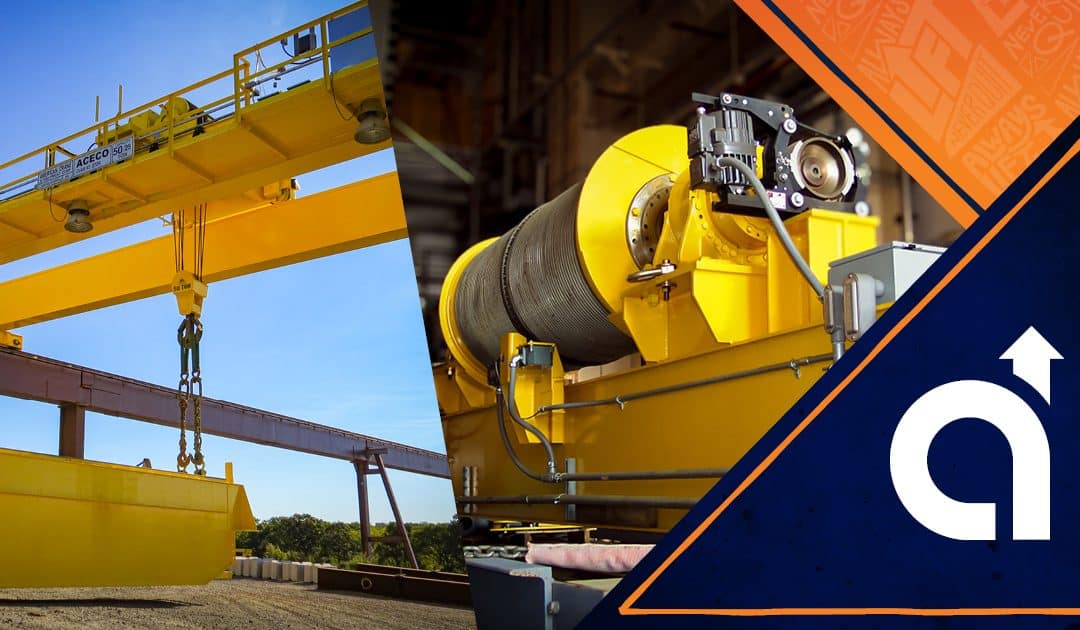
If you work around material handling, you’ve probably heard the words crane and hoist used interchangeably. It’s an easy mix-up — after all, both are designed to lift heavy loads. But while they work hand in hand, they play very different roles on the job. Understanding the distinction can help you choose the right equipment for your operation, improve safety, and make your workflow more efficient.
A Hoist is the Lifting Power
Think of a hoist as the muscle of the operation. A hoist’s main job is simple: lift and lower a load vertically. It can be powered manually, electrically, or pneumatically, and is usually attached to a fixed point or mounted on a trolley so it can move along a beam.
Common types include:
- Manual chain hoists, ideal for smaller lifts or backup power.
- Electric wire rope or chain hoists, which bring speed and consistency for frequent use.
- Air hoists, great for environments that demand spark resistance or continuous duty cycles.
In short, the hoist gets the heavy work off the ground — but it can’t move that load forward, backward, or side to side on its own.
A Crane is the Full-Range Mover
A crane, on the other hand, is the entire system that moves a load both vertically and horizontally. It typically includes a hoist as one of its components, but it also has a bridge, trolley, runway, and controls that allow for precise movement throughout a workspace.
There are many different crane styles to fit different applications, including:
- Overhead bridge cranes, commonly used in manufacturing and heavy industry.
- Gantry cranes, which run on wheels or rails for flexible mobility.
- Jib cranes, perfect for localized lifting in work cells.
- Monorail systems, which move along a fixed path.
Where the hoist provides lifting power, the crane provides reach and control — making it possible to lift, position, and place loads exactly where they’re needed.
Working Together
Here’s where the magic happens: cranes and hoists aren’t competitors — they’re partners. The hoist is mounted to the crane, doing the lifting and lowering, while the crane provides the structure to move the hoist and its load throughout the workspace.
Think of it like this: if the hoist is the engine, the crane is the car. One without the other is incomplete.
Choosing the Right Setup
Selecting the right crane and hoist combination depends on your space, load requirements, and workflow. For example, a small work cell may only need a jib crane with an electric chain hoist, whereas a large facility might use an overhead bridge crane with a wire rope hoist to cover long spans and heavier loads. Specialized environments, like cleanrooms or hazardous locations, may require custom materials and controls.
The key is understanding the job you need to do — then matching it with the system that makes that job safer and more efficient.
Final Thoughts
The difference between a crane and a hoist comes down to function and movement. A hoist lifts. A crane lifts and moves. Together, they make heavy lifting safer, faster, and more precise.
At American Crane and Equipment Corporation, we design and build world-class crane systems and offer a wide range of high-quality hoists from trusted brands to meet virtually any lifting requirement. Whether you need a custom overhead crane, a reliable hoist, or an integrated lifting solution, our team is here to help you find the perfect fit for your operation.