

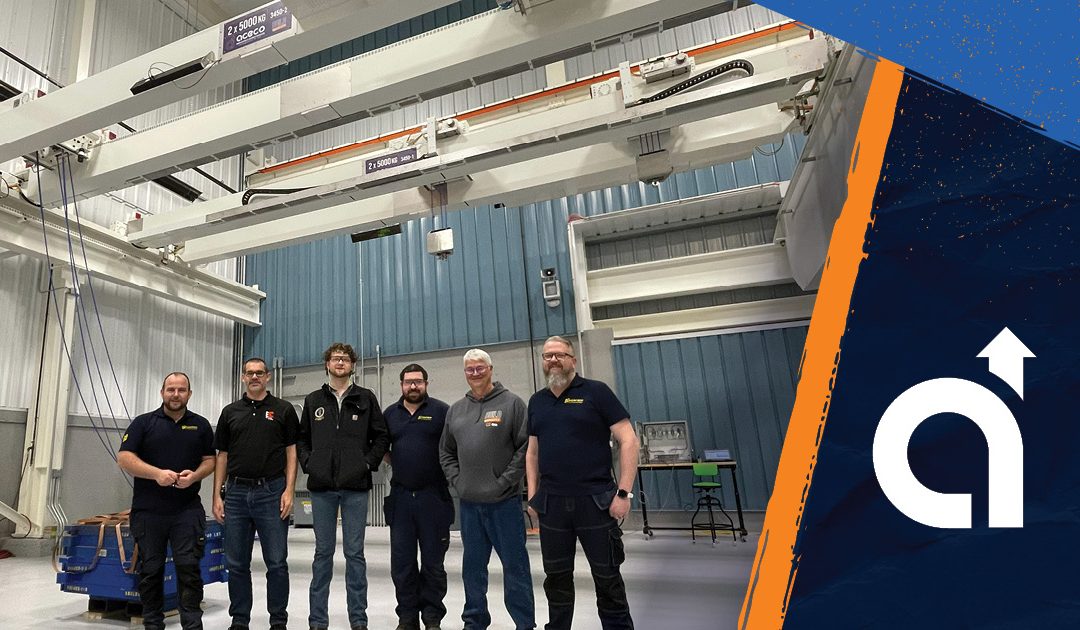
Semiconductor manufacturing is one of the most exacting industries in modern engineering — and not just because of what happens on a silicon wafer. Maintaining an environment that meets strict cleanroom standards is essential for producing reliable, high-yield chips. But while most discussions focus on air quality, filtration, and particulate counts, there’s another vital piece of the puzzle that often gets overlooked: material handling equipment, especially cleanroom-ready cranes.
Why Cleanroom Standards Matter to Lifting Equipment
A cleanroom is a carefully controlled environment designed to limit airborne particles down to fractions of a micron. In semiconductor fabrication, those microscopic particles can interfere with circuitry and reduce yield. Environmental classifications such as ISO 14644 establish measurable particle limits, and semiconductor fabrication facilities operate within those classifications to protect both process integrity and production efficiency.
Any equipment introduced into that space must align with those standards. Cranes are no exception. Traditional industrial cranes can generate particles through friction, corrosion, vibration, or poorly sealed components. In a standard manufacturing facility, that may not pose a concern. In a semiconductor cleanroom, it can directly impact product quality and uptime. Cleanroom standards, therefore, don’t stop at HVAC systems and gowning procedures — they extend to overhead lifting systems as well.
What Makes a Cleanroom Crane Cleanroom Ready
Cleanroom cranes are engineered specifically to operate without compromising the controlled environment around them. Rather than relying on standard finishes or exposed components, these systems are built with materials and surface treatments that minimize particulate generation and resist corrosion. Moving parts are designed to reduce friction and abrasion, limiting the possibility of shedding contaminants during operation.
Precision is equally important. Semiconductor facilities frequently lift and position sensitive tools, process equipment, and components that require controlled, smooth motion. Cleanroom cranes incorporate refined motion control systems to avoid sudden starts, stops, or vibration that could disturb airborne particles or impact delicate processes.
Customization also plays a significant role. Semiconductor fabrication facilities vary widely in layout, cleanliness classification, and workflow requirements. Cleanroom crane systems are typically engineered to integrate seamlessly into these unique environments, supporting both contamination control and operational efficiency
How Cleanroom Cranes Support Manufacturing Goals
Material handling inside a semiconductor cleanroom is about more than lifting heavy loads. It directly influences workflow, safety, and product protection. A properly designed cleanroom crane enables efficient movement of equipment and materials without disrupting environmental classifications. It reduces the need for manual handling, supporting operator safety and ergonomic performance within confined or highly controlled spaces.
At the same time, it protects sensitive assets. Semiconductor tools represent significant capital investment, and wafers at various stages of production carry substantial value. By minimizing vibration, particle generation, and electrostatic concerns, cleanroom cranes help safeguard both equipment and product throughout the manufacturing process
Integrating Standards with Crane Strategy
Cleanroom standards and crane systems are not separate considerations — they are interconnected elements of a comprehensive facility strategy. For semiconductor manufacturers, selecting lifting equipment that aligns with contamination control protocols is essential to maintaining yield and throughput.
For companies like American Crane & Equipment Corporation, this means designing and engineering crane systems that operate as quietly and precisely as the environments they serve. In semiconductor manufacturing, every particle counts — and every component in the facility, including the crane above, plays a role in protecting performance.